Tech Debt Explained: What It Really Costs You - and How AI Can Finally Fix It

Every engineering organization carries tech debt. The question isn't whether you have it - it's whether you're managing it, or whether it's managing you.
The Hidden Tax on Your Engineering Organization
Tech debt is the accumulated cost of shortcuts, outdated patterns, and deferred maintenance in your codebase. Like financial debt, it accrues interest every day you don't address it, the cost of working around it grows.
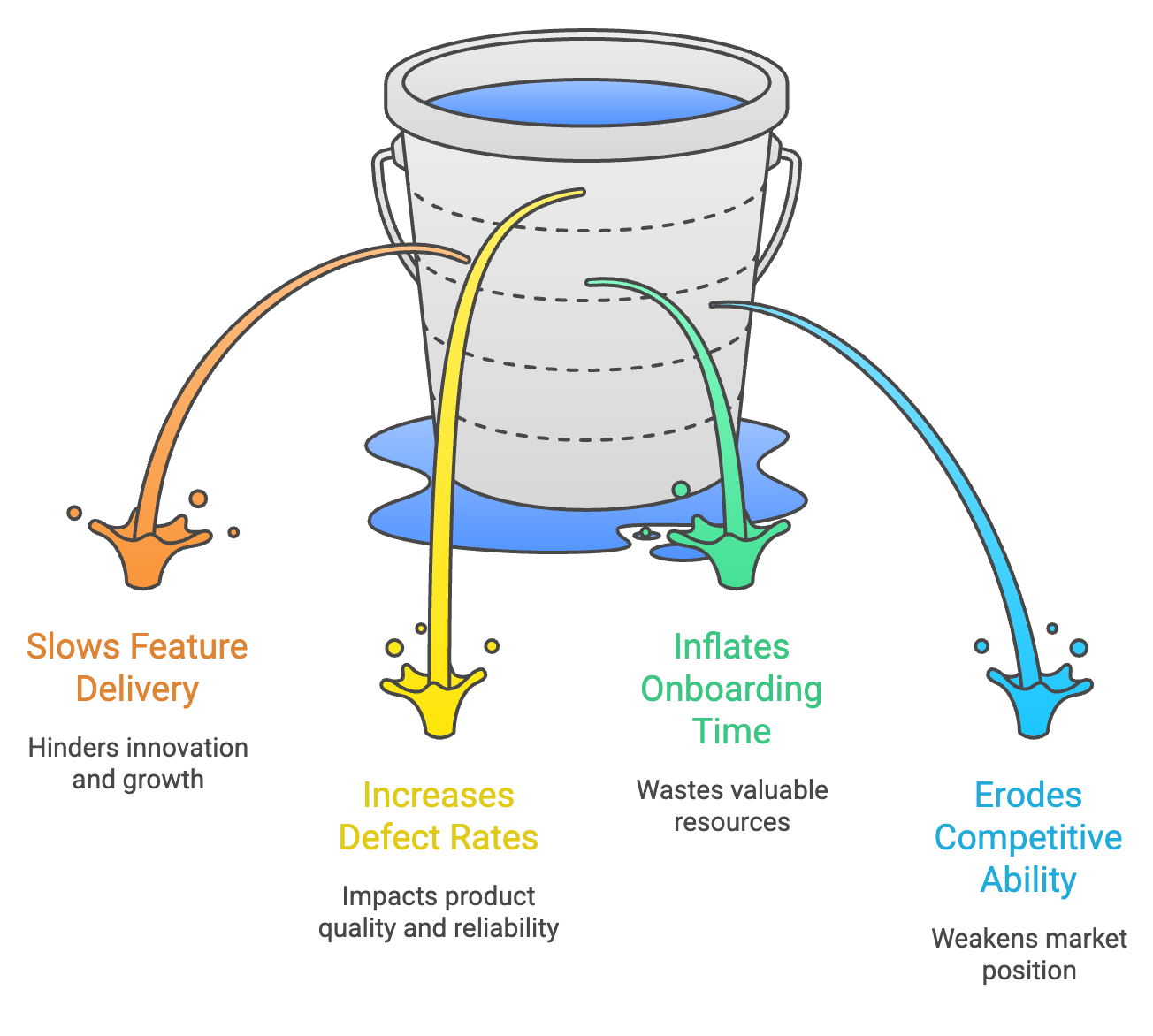
But here's the part most leaders miss: tech debt isn't just a developer problem. It's a business problem. It slows feature delivery, increases defect rates, inflates onboarding time, and quietly erodes your ability to compete. Studies consistently show that engineering teams spend 25–40% of their time dealing with tech debt rather than building new capabilities.
That's not a rounding error. That's a strategic drag on your entire organization.
The Five Faces of Tech Debt
Tech debt isn't a monolith. Understanding its categories is the first step toward tackling it systematically.
1. Code-Level Debt Duplicated logic, inconsistent patterns, deeply nested conditionals, and functions that have grown far beyond their original intent. This is the most visible form of tech debt and often the tip of the iceberg.
2. Architectural Debt Monolithic services that should have been decomposed years ago. Tight coupling between components that makes changes risky and slow. Data models that no longer reflect the domain. Architectural debt is harder to see but orders of magnitude more expensive to fix.
3. Infrastructure Debt Outdated dependencies, unsupported runtime versions, legacy CI/CD pipelines held together by duct tape, and manual deployment processes that should have been automated long ago. Infrastructure debt increases operational risk with every passing sprint.
4. Testing Debt Missing test coverage, flaky tests that everyone ignores, tests that pass but don't actually validate meaningful behavior, and test suites so slow that developers skip them entirely. Testing debt creates a false sense of security while real defects slip through.
5. Documentation and Knowledge Debt Tribal knowledge locked in the heads of senior engineers who joined three companies ago. Outdated READMEs. Missing runbooks. This debt compounds silently until someone leaves and suddenly, entire systems become black boxes.
Why Traditional Approaches Fall Short
Organizations have tried to address tech debt for decades. The playbook is well known: dedicate 20% of sprint capacity. Run periodic "tech debt sprints." Create a backlog and prioritize ruthlessly.
These approaches aren't wrong but they're insufficient at scale. Here's why:
Discovery is manual and incomplete. Engineers know about the debt in the code they touch regularly, but entire regions of the codebase remain unexamined. You can't fix what you can't see.
Prioritization is subjective. Without data-driven impact analysis, teams argue endlessly about which debt matters most. The loudest voice wins, not the highest-impact fix.
Remediation is slow and risky. Large-scale refactors are expensive, error-prone, and hard to justify against feature work. So the debt sits there, compounding.
Measurement is vague. "We reduced tech debt this quarter" means nothing without quantified before-and-after metrics tied to delivery velocity, defect rates, or developer experience.
Enter AI: A Force Multiplier for Tech Debt Reduction
AI doesn't eliminate the need for engineering judgment but it dramatically accelerates every phase of the tech debt lifecycle: discovery, prioritization, remediation, and prevention.
AI-Powered Discovery
Traditional static analysis tools flag syntax issues and known anti-patterns. AI goes further. Large language models can analyze codebases holistically, identifying architectural drift, inconsistent patterns across services, and code that has diverged from the team's current conventions even when no single rule was technically violated.
AI can scan entire repositories and surface debt that would take human reviewers weeks to catalog. It understands context: a function that's fine in isolation might be a liability given how it's called across 47 different services.
Practical applications:
- Semantic code analysis that identifies duplication beyond copy-paste (similar logic expressed differently across services).
- Dependency graph analysis to flag tightly coupled components and circular dependencies.
- Automated documentation gap detection - identifying undocumented public APIs, missing README sections, and stale runbooks.
AI-Driven Prioritization
Not all tech debt is equal. AI can correlate debt locations with delivery metrics to surface what actually matters.
Imagine knowing that the messy authentication module you've been ignoring is responsible for 35% of your failed deployments and adds an average of 2.3 days to any feature that touches it. That's not opinion, that's a data-driven business case for remediation.
Practical applications:
- Correlating code complexity metrics with defect density, deployment failure rates, and cycle time.
- Predicting which areas of debt will cause the most friction in the upcoming quarter based on the product roadmap.
- Generating prioritized remediation plans with estimated effort and expected impact on DORA metrics.
AI-Assisted Remediation
This is where AI delivers the most tangible value today. Modern AI coding assistants can handle a significant portion of routine refactoring work that previously consumed weeks of engineering time.
Practical applications:
- Automated migration of deprecated API patterns across hundreds of files.
- Intelligent refactoring suggestions that preserve behavior while improving structure.
- AI-generated test cases for legacy code that currently has zero coverage - making it safe to refactor.
- Automated dependency updates with compatibility verification and regression testing.
- Converting inline SQL to parameterized queries, updating authentication patterns, or migrating from callback-based to async/await patterns, at scale.
The key insight is that AI handles the mechanical work while engineers focus on the judgment calls: should this service be split? What's the right abstraction boundary? How do we migrate without downtime?
AI-Enabled Prevention
The cheapest tech debt is the debt you never create. AI-powered guardrails can catch debt at the point of introduction before it enters the codebase.
Practical applications:
- AI-enhanced code reviews that flag patterns known to create future debt, with explanations of why and suggested alternatives.
- Automated architecture decision records (ADRs) generated from PR patterns, creating institutional memory.
- Real-time feedback during development that nudges toward consistent patterns without blocking velocity.
- Smart quality gates in CI/CD pipelines that enforce standards dynamically based on the area of the codebase being modified.
Building a Tech Debt Strategy with AI
Buying an AI tool won't fix your tech debt problem any more than buying a gym membership will get you in shape. You need a strategy.
Step 1: Establish a Baseline Use AI-powered analysis tools to scan your codebase and generate a comprehensive debt inventory. Categorize by type (code, architecture, infrastructure, testing, documentation) and correlate with delivery metrics. You can't improve what you don't measure.
Step 2: Quantify Business Impact Connect debt to outcomes leadership cares about. Don't say "we have high cyclomatic complexity in the payments module." Say "the payments module is responsible for 40% of our escaped defects and adds 3 days to every feature that touches billing." AI-driven analytics make this correlation possible at scale.
Step 3: Integrate into the SDLC Tech debt reduction shouldn't be a separate initiative - it should be woven into every sprint. Use AI to flag debt in PRs as they're created. Allocate AI-assisted remediation capacity in every planning cycle. Make debt reduction visible in your engineering metrics dashboards.
Step 4: Automate the Mechanical Work Deploy AI coding assistants for the high-volume, low-judgment refactoring tasks. Dependency updates, pattern migrations, test generation for legacy code, these are perfect candidates for AI-assisted automation with human review.
Step 5: Measure and Iterate Track the impact of debt reduction on the metrics that matter: deployment frequency, lead time for changes, change failure rate, and mean time to recovery (the four DORA metrics). If your debt reduction work isn't moving these numbers, reassess your prioritization.
The ROI Case for AI-Powered Tech Debt Reduction
Let's put numbers to this. Consider a 200-person engineering organization where developers spend 30% of their time dealing with tech debt. That's the equivalent of 60 full-time engineers consumed by debt-related friction at a fully loaded cost that likely exceeds $10M annually.
If AI-powered tools and processes can reduce that friction by even 30%, you've reclaimed the equivalent of 18 engineers, without a single hire. More importantly, those engineers are now spending their time on feature development, innovation, and the work that actually moves your business forward.
The math isn't complicated. The hard part is starting.
The Bottom Line
Tech debt is inevitable. Letting it accumulate unchecked is a choice - and an expensive one. AI doesn't make tech debt disappear overnight, but it fundamentally changes the economics of managing it. Discovery that took weeks now takes hours. Prioritization that was subjective is now data-driven. Remediation that required senior engineers can be partially automated with human oversight.
The organizations that figure this out first won't just have cleaner codebases. They'll ship faster, fail less, onboard engineers quicker, and respond to market changes before their competitors even finish their planning meetings.
Tech debt is a strategy problem disguised as a technical one. AI is the tool that finally makes the strategy executable at scale.


Comments ()