The Future of Software Engineers in the AI Era: From Writing Code to Leading Agents
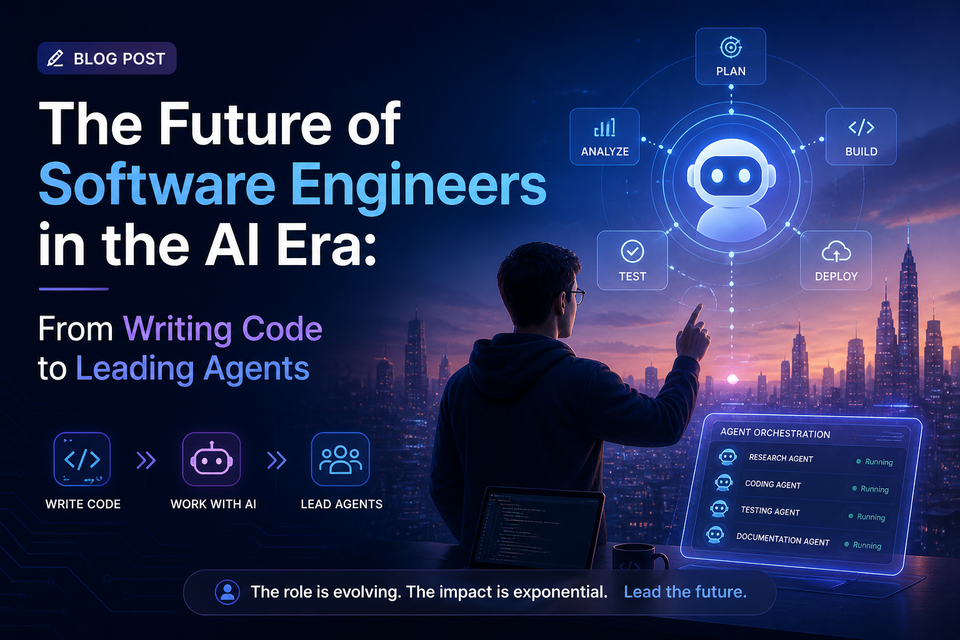
Software engineers won't be writing code anymore. They'll be building a team of agents.
The Biggest Job Transformation in Tech History Is Already Underway
Let's skip the hedging. The role of software engineer is undergoing the most fundamental transformation since the profession was created. Not a gradual evolution. Not a minor retooling. A complete redefinition of what it means to build software.
For sixty years, being a software engineer meant one thing at its core: writing code. Translating human intent into machine instructions, line by line, function by function, commit by commit. The tools evolved - from punch cards to terminals to IDEs to cloud-based editors - but the fundamental act remained the same. Hands on keyboard. Human writes code. Machine executes code.
That era is ending.
What's replacing it isn't unemployment. It's a promotion. Engineers are moving from individual contributors who write code to team leads who orchestrate agents that write code for them. The keyboard is becoming optional. The terminal is becoming a conversation. And the engineer's value is shifting from how fast they can type to how clearly they can think.
What the New Job Actually Looks Like
The engineer of the near future won't open an IDE to start their day. They might not open one at all. Instead, they'll work more like a technical team lead managing a squad of highly capable but narrowly focused specialists - except those specialists are AI agents.
Here's what the job becomes:
Creating requirements - not as Jira tickets, but as executable specs that agents understand. Today's product requirements are written for humans: ambiguous, context-dependent, full of implied knowledge. Agent-ready requirements are precise, testable, and machine-parseable. Writing them well becomes a core engineering skill - arguably more important than writing code, because a well-specified requirement generates correct code on the first pass, while a vague one generates endless rework.
Building knowledge bases that agents query. Agents are only as good as the context they operate in. Engineers will curate, structure, and maintain the knowledge bases that their agents draw from - codified architecture decisions, API contracts, business rules, coding standards, past incident reports, and domain-specific context. This is the institutional memory that turns a generic AI into your team's AI.
Setting up feedback loops so agents learn from their actions. When an agent generates code that fails a test, triggers a performance regression, or gets flagged in code review - that signal needs to flow back into the agent's behavior. Engineers will design these feedback mechanisms: the monitoring, the evaluation criteria, the correction protocols. The agents do the work. The engineer designs the system that makes the work get better over time.
Creating self-improving systems that get better without human intervention. This is the endgame. Not one-off features, but flywheels - systems where every cycle of plan-build-test-deploy-observe generates data that improves the next cycle. Engineers will build flywheels, not features. The value compounds. The system learns. And the engineer's leverage multiplies with every iteration.
From Hands-On Keyboard to Hands-Off Orchestration
Traditional engineering was hands-on keyboard. You thought about the problem, and then you typed the solution. The bottleneck was your typing speed, your memory of API signatures, your ability to hold complex state in your head while debugging at 2 AM.
Agent engineering is hands-off orchestration. You think about the problem, define it precisely, and delegate the implementation entirely. The bottleneck shifts to your ability to decompose problems, specify behavior, evaluate outputs, and course-correct when the agent drifts.
It's exactly like being a team lead.
Good team leads don't write all the code themselves. They define objectives, set quality standards, monitor performance, and course-correct when needed. They spend their time on architecture decisions, system design, and making sure the team is solving the right problems the right way. The actual coding is delegated.
That's what engineering is becoming, except the team you're leading is made of agents.
This isn't theoretical. Tools like Claude Code are already moving engineers away from the IDE entirely. It's a terminal application where you describe what you want built, and the agent builds it - in your environment, with your dependencies, against your codebase. No IDE. No syntax highlighting. No manual debugging. Just a conversation with an agent that understands your intent and executes against it.
Many engineers have already taken this further. They're not even typing anymore - they're speaking applications into existence with voice, directing an army of specialized agents through natural language while reviewing the outputs on screen. The keyboard is becoming a legacy input device for a generation of engineers who've realized that their value was never in the typing.
The Skills That Matter Now
This transformation doesn't devalue engineering - it revalues it. The skills that made you a good engineer in the old paradigm (deep language expertise, fast typing, memorized APIs) become table stakes or irrelevant. The skills that make you a great engineer in the new paradigm are different:
Systems thinking over syntax knowledge. Understanding how components interact, where failure modes live, and how changes cascade through a system matters more than knowing the difference between useEffect and useLayoutEffect. Agents handle syntax. Humans handle systems.
Precise specification over fast implementation. The ability to articulate exactly what you want - including edge cases, error handling, performance constraints, and security requirements - becomes the primary engineering skill. Vague requirements produce vague code, regardless of whether a human or an agent writes it. The engineer who can write a spec so clear that an agent nails it on the first try is 10x more productive than one who writes vague prompts and iterates endlessly.
Evaluation and judgment over production. Knowing whether generated code is correct, performant, secure, and maintainable requires deep engineering knowledge - arguably deeper than writing the code yourself. You need to understand what good looks like without having written it. This is the same skill that distinguishes a great tech lead from a great individual contributor: the ability to review, assess, and improve work at scale.
Architecture over implementation. When implementation is cheap and fast, architecture becomes the differentiator. How you structure systems, define boundaries, manage state, and design for evolution determines the long-term health of the software. Agents can implement any architecture you give them - but choosing the right architecture still requires human judgment informed by experience, business context, and technical taste.
Agent orchestration. This is the genuinely new skill. Understanding how to decompose a task across multiple specialized agents, manage their coordination, handle conflicts between their outputs, and design the feedback systems that improve their performance over time. It doesn't have a clean analog in the old paradigm, and the engineers who master it first will have an enormous advantage.
What Happens to Junior Engineers?
This is the question everyone asks, and it deserves an honest answer.
The traditional junior engineer on-ramp - write small features, fix bugs, learn the codebase through hands-on contribution - is eroding. If agents can handle implementation, what's left for a junior to do?
The answer is that the junior role transforms, not disappears. Juniors will still need to learn systems thinking, specification writing, code evaluation, and architecture - but the learning path changes. Instead of learning by writing code from scratch, they'll learn by directing agents, reviewing agent output, and understanding why the agent made specific choices.
In some ways, this is better. A junior engineer working with agents gets exposure to more code, more patterns, and more systems than one who spends six months writing CRUD endpoints. The learning surface area explodes. The risk is that without the struggle of writing code themselves, the deep intuition that comes from debugging your own mistakes might develop more slowly.
The organizations that solve junior onboarding in the agent era will have a massive talent advantage. It's an open problem, and it's worth taking seriously.
The Organizational Implications
When individual engineers become 5–10x more productive through agent orchestration, the math changes for how you staff and structure teams.
Smaller teams, bigger scope. A team of five engineers directing agent swarms can cover the surface area that used to require twenty. This means fewer teams, broader ownership, and less coordination overhead. The two-pizza team gets even smaller - and even more capable.
The senior-to-junior ratio inverts. In the agent era, you need more senior engineers (who can architect, evaluate, and orchestrate) and fewer junior engineers (who traditionally did the implementation work). This has real implications for hiring pipelines, career ladders, and organizational structure.
Platform engineering becomes even more critical. Agents need platforms to operate on - CI/CD pipelines that run their generated code, testing frameworks that validate their output, deployment systems that promote their changes safely, and observability stacks that monitor the results. The platform engineering team becomes the foundation that makes agent-driven development possible at scale.
Quality engineering evolves into agent evaluation. QE teams shift from writing test cases to designing evaluation frameworks for agent-generated code. Are the agents producing secure code? Performant code? Maintainable code? This requires new metrics, new tools, and a new mental model for what quality means when the producer isn't human.
The Timeline Is Faster Than You Think
Most of this isn't five years away. The building blocks exist today.
AI coding assistants are already handling 30–50% of code generation in organizations that have adopted them fully. Claude Code and similar terminal-based agents are already letting engineers build without an IDE. Voice-to-code workflows are already in daily use by early adopters. Agent orchestration frameworks are already moving from experimental to production.
The transition won't be a single moment. It'll be a gradual shift where the percentage of code written by agents climbs from 30% to 50% to 80% to 95%, and the engineer's role evolves in lockstep. Some engineers will resist and cling to the keyboard. Others will lean in and discover that they're capable of 10x the impact they had before - not because they're working harder, but because they're working at a higher level of abstraction.
The engineers who thrive won't be the ones who write the best code. They'll be the ones who lead the best agents.
The Bottom Line
The software engineering profession isn't dying. It's growing up. For decades, we've been valued for our ability to translate intent into code. In the AI era, we'll be valued for our ability to translate intent into systems - systems of agents, feedback loops, knowledge bases, and self-improving flywheels that deliver software at a pace and quality that no human-only team could match.
The keyboard was never the point. The thinking was always the point. AI just makes that undeniably, unavoidably clear.
The future of software engineering isn't writing code. It's leading the agents that do.

Comments ()