The AI-Enhanced Product Development Lifecycle: From Discovery to Delivery
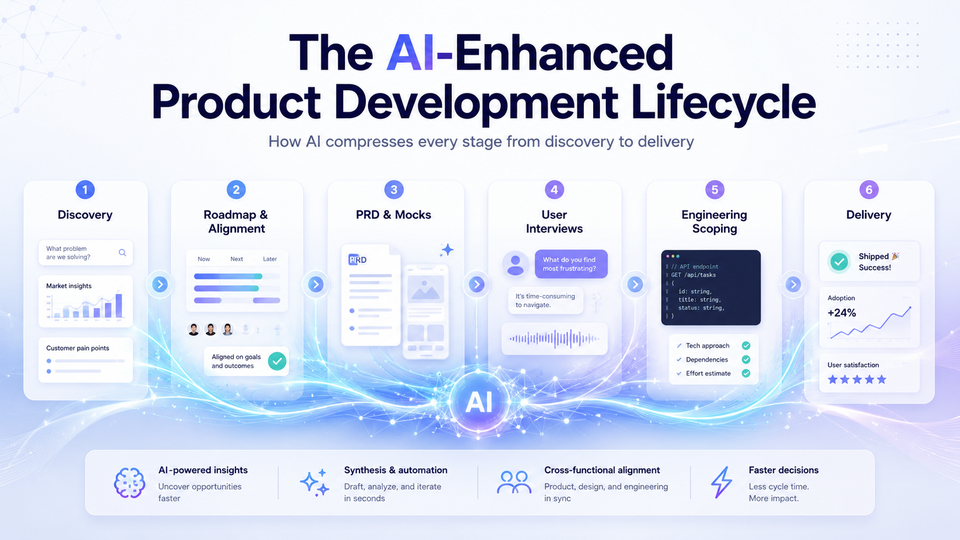
AI isn't replacing your product development process - it's compressing it. Teams that embed AI into every stage of the lifecycle are shipping better products in half the time. Here's the playbook.
The Old Lifecycle Is Too Slow for the New Market
Product development has always followed a roughly linear path: discover a problem, align on a solution, prototype it, validate it with users, scope the engineering work, and build it. That hasn't changed. What has changed is the speed at which markets move, competitors ship, and user expectations evolve.
The traditional lifecycle - where each phase takes weeks and handoffs between product, design, and engineering create information loss, simply can't keep up. Teams that still run discovery workshops for a month, wait two weeks for design mockups, and then spend another month in engineering scoping are losing to teams that compress the entire cycle into days.
AI doesn't change what you do. It changes how fast and how well you do it at every stage.
The Six Stages of AI-Enhanced Product Development
The AI-enhanced lifecycle consists of six distinct phases, each owned by the right team - but supercharged by AI tooling that eliminates busywork, surfaces insights faster, and keeps fidelity calibrated to the decision being made.
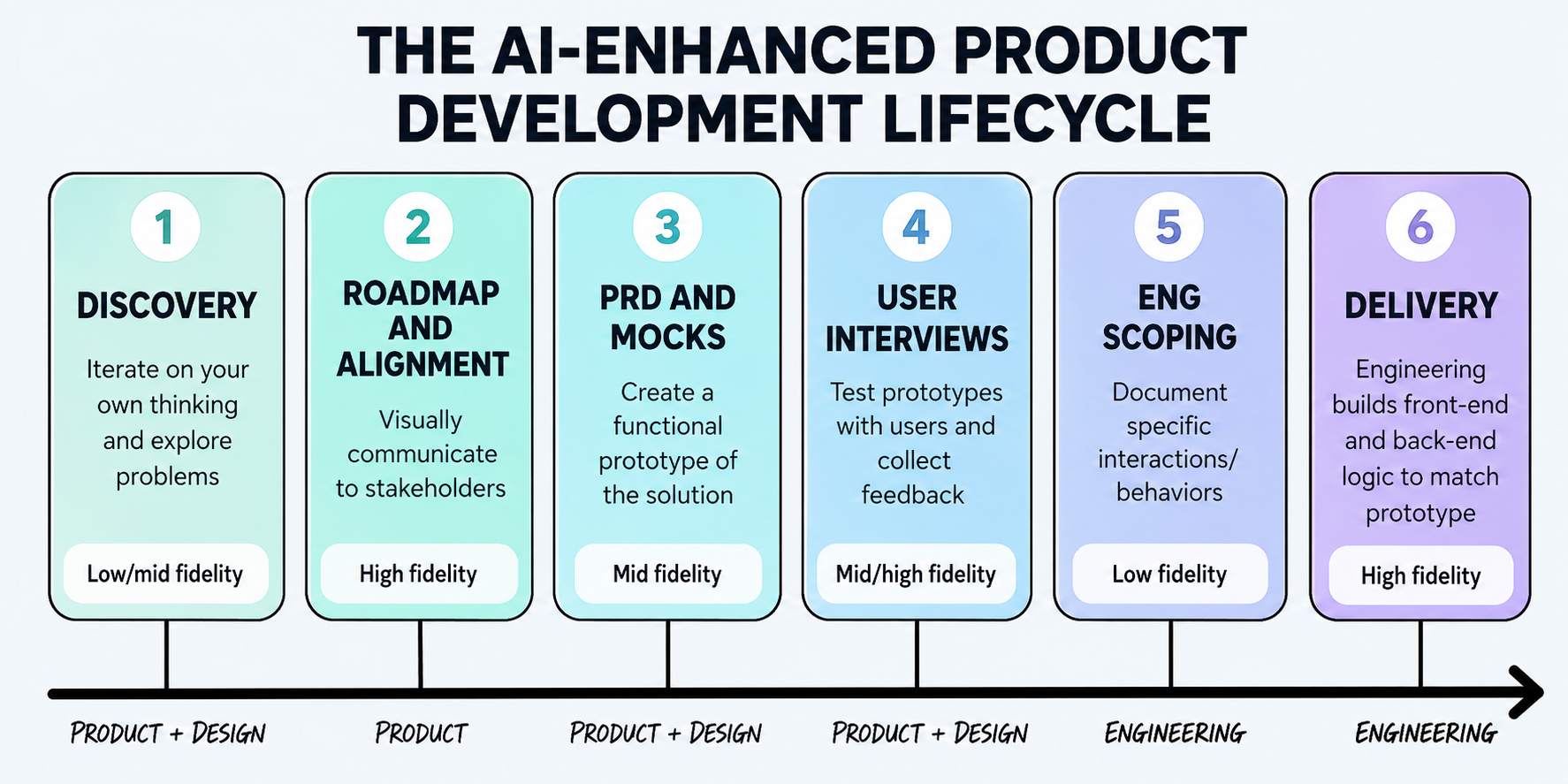
Stage 1: Discovery
Owner: Product + Design | Fidelity: Low/Mid
Discovery is where you iterate on your own thinking and explore the problem space. It's deliberately low-fidelity - the goal isn't polish, it's clarity. You're asking: What problem are we solving? For whom? Why now?
Traditionally, this phase involves reading through customer feedback, analyzing support tickets, reviewing competitor positioning, and synthesizing research, all of which eats up days of a PM's time before a single insight emerges.
How AI transforms Discovery:
AI dramatically compresses the research and synthesis phase. Instead of manually reading hundreds of support tickets, AI can cluster them by theme, extract sentiment patterns, and surface the top unmet needs in minutes. Instead of spending a day crafting a competitive landscape, AI can pull and summarize competitor positioning, feature sets, and recent product launches.
But the real unlock is iterative thinking at speed. AI serves as a thinking partner, you can throw half-formed hypotheses at it and get structured pushback, alternative framings, and data points you hadn't considered. The PM still makes the judgment calls, but the cycles between "I think the problem is X" and "here's the evidence for and against X" shrink from days to hours.
Practical applications:
- Automated clustering and sentiment analysis across customer feedback channels (support tickets, NPS comments, sales call transcripts).
- Competitive intelligence synthesis - feature comparison matrices, positioning analysis, and market gap identification.
- Rapid hypothesis generation and stress-testing with AI as a sparring partner.
- Auto-generated problem briefs that synthesize research into a structured discovery document.
Stage 2: Roadmap and Alignment
Owner: Product | Fidelity: High
Once you've identified the right problem, you need to communicate it to stakeholders and secure alignment. This is a high-fidelity stage - executives, cross-functional partners, and engineering leadership need to see a clear, compelling narrative about what you're building, why it matters, and where it fits in the broader product strategy.
This is where most teams lose weeks. Building a polished roadmap deck, writing the strategy narrative, creating the prioritization framework, and running the alignment meetings takes significant PM time - and often multiple revision cycles.
How AI transforms Roadmap and Alignment:
AI can generate first drafts of roadmap presentations, strategy narratives, and prioritization frameworks in minutes. It can take your discovery research and automatically structure it into a stakeholder-ready format - complete with data-backed justifications, risk callouts, and dependency mapping.
More importantly, AI helps you simulate alignment conversations before they happen. Feed it the likely objections from engineering ("this is too complex"), design ("this doesn't match our design system"), or leadership ("how does this impact Q3 revenue?") and get pre-built responses grounded in your research.
Practical applications:
- AI-generated roadmap decks and strategy narratives from discovery inputs.
- Automated prioritization scoring (RICE, ICE, WSJF) with data pulled from analytics and feedback systems.
- Stakeholder objection modeling - anticipate pushback and prepare evidence-based responses.
- Dependency detection across teams and systems to flag alignment needs early.
- Auto-generated executive summaries tailored to different audience levels (board, VP, team lead).
Stage 3: PRD and Mocks
Owner: Product + Design | Fidelity: Mid
This is where the solution takes shape. You're creating a functional prototype of the solution, detailed enough to test, but not so polished that iteration is expensive. The PRD defines the what and why; the mocks show the how.
Writing a solid PRD used to take days. Creating interactive mocks added another design cycle. The back-and-forth between PM and design on "is this what we mean?" added more. This stage is where many teams stall.
How AI transforms PRDs and Mocks:
AI collapses the PRD creation process from days to hours. Starting from your discovery insights and roadmap decisions, AI can generate a structured PRD draft complete with user stories, acceptance criteria, edge cases, and technical considerations. It won't be perfect, but it gives you an 80% starting point that you refine rather than build from scratch.
On the design side, AI-powered tools can generate UI concepts, wireframes, and even interactive prototypes directly from product descriptions. The designer's role shifts from pushing pixels on the first draft to curating, refining, and elevating AI-generated starting points.
Practical applications:
- AI-generated PRD drafts from roadmap inputs, including user stories, acceptance criteria, and edge cases.
- Automated edge case and failure mode identification based on similar features and historical patterns.
- AI-powered wireframe and prototype generation from natural language descriptions.
- Consistency checking against existing design systems and UI patterns.
- Automatic cross-referencing with existing features to flag conflicts, redundancies, or integration opportunities.
Stage 4: User Interviews
Owner: Product + Design | Fidelity: Mid/High
You've built a prototype. Now you put it in front of real users and collect feedback. This stage validates (or invalidates) your assumptions before you invest serious engineering resources.
User research is one of the most valuable and most underinvested stages of product development. It's time-intensive: recruiting participants, conducting interviews, synthesizing notes, identifying patterns, and distilling findings into actionable insights often takes 2–4 weeks.
How AI transforms User Interviews:
AI doesn't replace the human conversation, empathy and nuance still require a human interviewer. But everything around the conversation gets dramatically faster.
AI can generate interview scripts tailored to your specific hypotheses. During interviews, real-time transcription with automated tagging captures insights as they happen. After interviews, AI synthesis across all sessions surfaces the patterns, contradictions, and surprises in minutes rather than days.
The biggest unlock: AI can help you reach statistical confidence faster by identifying when you've hit thematic saturation, the point where additional interviews are unlikely to surface new insights.
Practical applications:
- AI-generated interview scripts aligned to specific hypotheses and user segments.
- Real-time transcription with automated tagging by theme, sentiment, and feature area.
- Cross-interview synthesis that identifies patterns, outliers, and contradictions.
- Automated research reports with key findings, supporting quotes, and recommended actions.
- Thematic saturation detection to optimize sample sizes.
- Sentiment and emotion analysis across sessions to surface unspoken frustrations.
Stage 5: Engineering Scoping
Owner: Engineering | Fidelity: Low
This is where the prototype hands off to engineering for detailed technical scoping. Engineers document specific interactions, behaviors, data models, API contracts, and system dependencies. The output is low-fidelity from a visual perspective, what matters is precision on what needs to be built and how the pieces fit together.
Engineering scoping is where ambitious product timelines go to die. The gap between "this looks simple in the mock" and "this requires changes to four services, a database migration, and a new event pipeline" is where most delivery estimates blow up.
How AI transforms Engineering Scoping:
AI can analyze the PRD and mocks alongside the existing codebase to generate preliminary technical specifications. It can identify which services are affected, flag potential breaking changes, estimate complexity based on similar past work, and surface architectural decisions that need to be made early.
This doesn't replace the technical judgment of senior engineers, but it eliminates the hours of "let me trace through the code to understand what this change actually touches" that typically precedes any meaningful scoping discussion.
Practical applications:
- Automated impact analysis - given a feature description, identify which services, APIs, and data models are affected.
- AI-generated technical design documents from PRD inputs, including proposed architecture, data flow, and API contracts.
- Complexity estimation based on historical velocity data and codebase analysis.
- Dependency mapping that flags cross-team coordination needs before they become blockers.
- Risk identification - legacy code areas, test coverage gaps, and performance-sensitive paths that the feature will touch.
- Automated generation of technical tickets and task breakdowns from scoping documents.
Stage 6: Delivery
Owner: Engineering | Fidelity: Production
Engineering builds the front-end and back-end logic to match the prototype. This is where the product goes from concept to code, through testing, and into production.
Delivery is the most mature stage for AI adoption, AI-assisted coding tools are already widely deployed and delivering measurable productivity gains. But the impact goes far beyond code completion.
How AI transforms Delivery:
AI accelerates every aspect of the build phase. Code generation handles the boilerplate and routine patterns. AI-powered code review catches bugs, security issues, and architectural violations before they reach main. Automated test generation creates coverage for new features and edge cases. Smart CI/CD pipelines optimize build times, predict failures, and auto-remediate flaky tests.
The most forward-looking teams are also using AI to close the loop between delivery and discovery, automatically generating release notes, tracking feature adoption metrics, and surfacing early signals that feed the next discovery cycle.
Practical applications:
- AI-assisted code generation for boilerplate, patterns, and routine implementation work.
- Intelligent code review that checks for bugs, security vulnerabilities, performance regressions, and style consistency.
- Automated test generation - unit, integration, and end-to-end tests derived from PRD acceptance criteria.
- Smart CI/CD optimization - build caching, test parallelization, predictive failure detection, and flaky test management.
- AI-generated release notes and changelog entries from PR descriptions and commit history.
- Feature adoption monitoring with automated alerts when usage patterns diverge from expectations.
- Automated rollback recommendations when post-deployment metrics degrade.
The Cross-Cutting Themes
Three principles run through every stage of the AI-enhanced lifecycle:
1. Fidelity Calibration Each stage has an appropriate level of fidelity, and AI helps you stay calibrated. Discovery should be low-fidelity (ideas and hypotheses), not polished decks. Engineering scoping should be technically precise, not visually designed. AI tools that generate content at the right level of polish for each stage prevent the common trap of over-investing in artifacts that will change.
2. Handoff Elimination The biggest time sink in product development isn't any single stage, it's the handoffs between them. AI reduces handoff friction by automatically translating outputs from one stage into inputs for the next. Discovery insights flow into roadmap narratives. PRDs generate technical specifications. User interview findings update acceptance criteria. The context loss that plagues traditional handoffs shrinks dramatically.
3. Continuous Feedback Loops AI enables tighter feedback loops between stages. You don't have to wait for a formal user interview phase to get signal, AI can continuously analyze support tickets, usage data, and feedback channels and inject insights into any active stage. The lifecycle becomes less of a linear sequence and more of an iterative loop where learning is constant.
Who Owns What And Why It Matters
One of the most important aspects of the AI-enhanced lifecycle is that it doesn't change ownership. Product + Design own Discovery, PRDs and Mocks, and User Interviews. Product owns Roadmap and Alignment. Engineering owns Scoping and Delivery.
AI amplifies each team's capabilities without blurring the lines of responsibility. The PM who uses AI to draft a PRD in two hours instead of two days still owns the product decisions embedded in that PRD. The engineer who uses AI to generate a technical spec still owns the architectural choices.
This matters because one of the biggest risks of AI adoption is diffusion of accountability. When "the AI wrote it," who's responsible for the quality? The answer should always be clear: the team that owns the stage owns the output, regardless of how it was produced.
The Compound Effect
The real power of AI across the lifecycle isn't in any single stage improvement, it's in the compound effect. When discovery takes days instead of weeks, alignment takes hours instead of days, PRDs are drafted in hours instead of days, and engineering scoping is pre-analyzed before the meeting even starts, the entire cycle compresses dramatically.
Teams that fully embrace AI across all six stages are reporting 40–60% reductions in time from idea to production. Not by cutting corners or skipping stages, but by eliminating the dead time, manual synthesis, and context loss that traditionally consumed most of the calendar time.
The product development lifecycle isn't changing. It's accelerating. The teams that accelerate with it will define the next generation of products. The ones that don't will spend the next year building what their competitors shipped last quarter.



Comments ()