AI in engineering covers how coding assistants and agents change the way software gets built, reviewed, and measured. These posts draw on a published January 2025 study of an AI coding assistant rollout across a 400+ engineer organization, where I was one of the researchers. Expect adoption patterns, the metrics that break first, and the second-order costs teams discover after the first quarter.
AI adoption should strengthen existing productivity goals, not create a parallel strategy. Learn how to evaluate AI tools through productivity metrics, technical debt, team health, pilots, and rollback triggers.
AI token usage, prompts, seats, and AI-generated code can show adoption -but not productivity. Learn why “tokenmaxxing” is a vanity metric and what engineering leaders should measure instead.
Faster code generation does not produce cleaner code. It produces more code. Here is the loop we run instead of debt sprints: scheduled scans, agent-generated pull requests, and two numbers that tell you whether it is actually working.
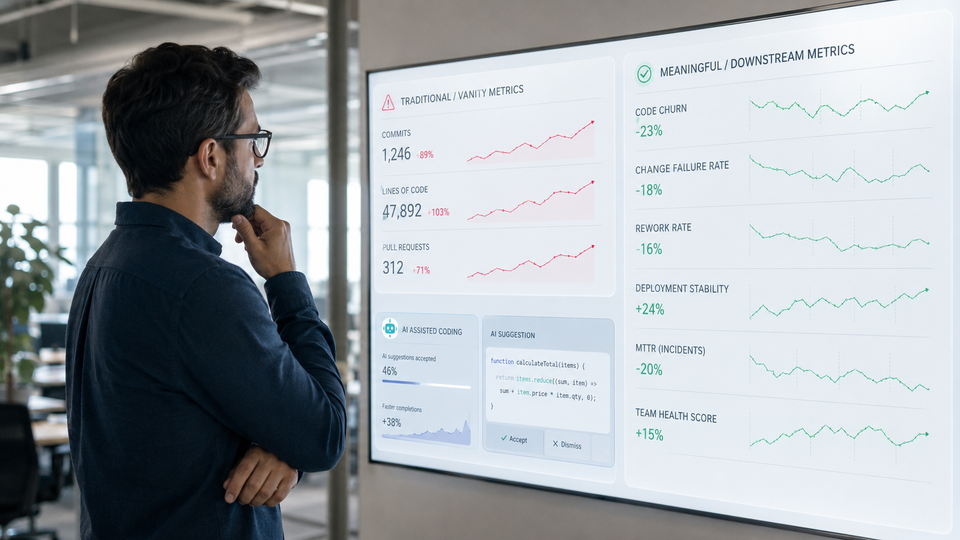
AI hasn't made engineering productivity unmeasurable. It's made the easy metrics dangerous, inflating commits and lines of code automatically, widening the gap between feeling fast and being fast, and hiding real costs downstream. Here's what breaks, why, and what to measure instead.
Tech debt is a hidden tax on engineering, quietly consuming 25–40% of developer capacity. Traditional approaches can't keep up. AI doesn't make tech debt disappear, but it changes the economics of managing it, turning a reactive chore into a measurable, strategic advantage for organizations.