Productivity vs Platform Engineering Team Practical Differences
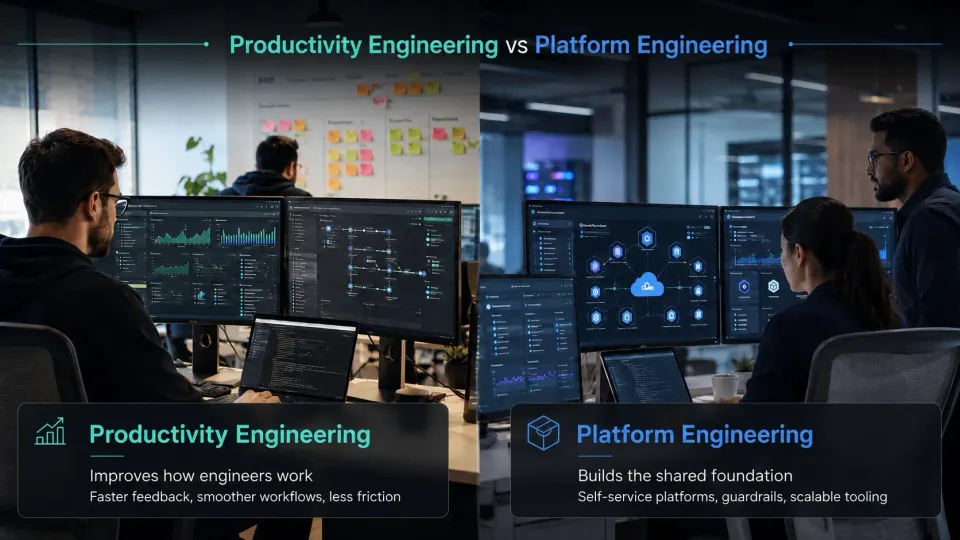
A productivity engineering team focuses on making the day-to-day work of engineers faster and easier, while a platform engineering team focuses on building the shared technical foundation that lets engineering teams operate at scale.
The distinction can feel blurry because both teams improve developer experience, both work with engineering tooling, and both may touch areas such as CI/CD, automation, AI, and internal developer platforms.
The practical difference is where they focus:
Productivity Engineering optimizes how engineers work. Platform Engineering builds the platform they work on.
Productivity Engineering starts with developer friction. It looks for slow feedback loops, repetitive work, difficult local environments, inefficient workflows, technical debt, and other obstacles that make engineering harder than it needs to be. It measures those problems, prioritizes them, and then works to improve them.
Platform Engineering starts with shared capabilities. It builds internal platforms, APIs, pipelines, templates, infrastructure abstractions, and self-service systems that engineering teams can use consistently across the organization.
Both can make developers dramatically more productive, but they approach the problem from different directions.
What a Productivity Engineering Team Actually Does
A productivity engineering team looks at the friction engineers encounter while building and shipping software and asks:
What is slowing developers down, and how can we remove it?
That can include everything from slow builds and repetitive tasks to poor local development environments, cumbersome pull-request workflows, long feedback loops, or too much context switching.
Typical responsibilities include:
- Improving local development environments
- Automating repetitive engineering tasks
- Improving IDEs, developer tooling, and workflows
- Reducing context switching
- Optimizing pull-request and CI feedback loops
- Improving build and test performance
- Identifying bottlenecks in the software delivery lifecycle
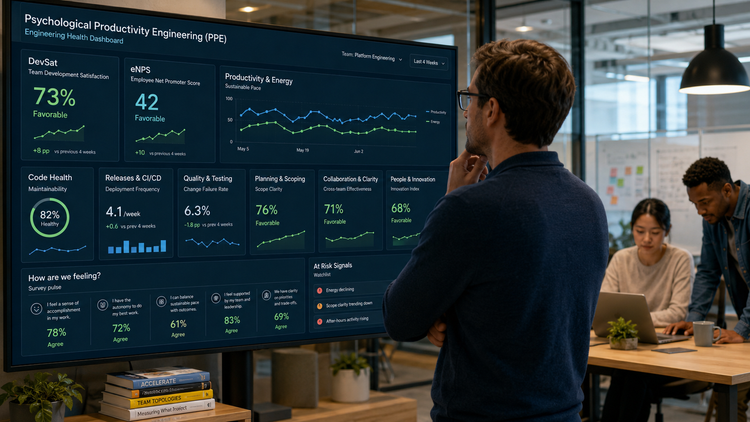
- Measuring engineering productivity and developer experience
- Tracking technical debt and its impact on delivery
- Measuring the impact of AI and other engineering tools
- Running improvement programs and experiments
Measurement is important, but measurement is not the product.
The purpose of measurement is to find opportunities to improve the engineering system.
For example, the team might discover that developers regularly wait 15 minutes for CI before receiving feedback.
A productivity engineering team does not stop at putting that number on a dashboard. It investigates why the pipeline is slow and looks for ways to reduce the delay through caching, test selection, parallelization, workflow changes, or other improvements.
The team then measures the result.
Did CI actually get faster?
Did developers receive feedback sooner?
Did pull requests move faster?
Did the change simply move the bottleneck somewhere else?
This is why productivity engineering combines engineering work with measurement. The team needs enough data to identify the right problems and enough technical capability to actually improve them.
The outcome is straightforward:
Engineers spend less time waiting, fighting tools, or performing repetitive work, and more time building and shipping software.
Measurement Still Matters
Productivity Engineering should not become a reporting function, but measurement remains one of its most important tools.
The team may track:
- Cycle time
- Pull-request feedback time
- Build duration
- Test duration
- Deployment frequency
- Developer satisfaction
- Perceived productivity
- Incident patterns
- Technical debt
- AI adoption
- Tool usage
- Time lost to repetitive work
Balanced frameworks such as DORA and SPACE can help provide context, but the goal is not to maximize individual metrics.
The goal is to understand where friction exists and whether improvements actually work.
This distinction matters because engineering metrics can easily become misleading.
A team may merge more pull requests while spending more time fighting CI. Deployment frequency may increase while developer satisfaction falls. AI may generate more code while increasing review time.
Productivity Engineering needs to understand the system rather than optimize a single number.
That also means watching for metric gaming, inconsistent definitions, and incomplete data.
If a metric definition changes halfway through an improvement program, the team should document the change and recalculate historical baselines when necessary so that trends remain comparable.
In practice, a productivity team may maintain a living glossary of important signals, including how they are calculated and when definitions change.
What a Platform Engineering Team Actually Does
Platform Engineering starts with a different question:
What shared capabilities should we provide so teams can build and operate software independently and safely?
Platform teams focus on the shared foundations that development teams need.
Typical responsibilities include:
- Designing and operating internal developer platforms
- Providing self-service APIs and services
- Creating standardized CI/CD capabilities
- Building templates and golden paths
- Providing infrastructure abstractions
- Implementing security and compliance guardrails
- Managing observability capabilities
- Standardizing infrastructure and common tooling
- Ensuring platform reliability and scalability
Instead of every product team figuring out Kubernetes, deployment pipelines, secrets, monitoring, infrastructure provisioning, and service configuration independently, the platform team turns those capabilities into reusable building blocks.
A developer might click Create Service in an internal developer portal and receive a repository, deployment pipeline, infrastructure configuration, observability setup, and production-ready service template.
That is Platform Engineering.
The outcome is:
Teams can build and operate software independently without becoming infrastructure experts.
Platform teams also need to manage an important trade-off.
A platform that tries to support every possible use case becomes difficult to maintain. A platform that is too opinionated can force teams to build workarounds.
Good Platform Engineering therefore creates strong golden paths for common cases while providing clear mechanisms for legitimate exceptions.
The Practical Difference
The easiest way to distinguish the teams is by looking at the problem each one is trying to solve.
| Productivity Engineering | Platform Engineering | |
|---|---|---|
| Primary focus | How engineers work | What engineers build and run on |
| Main goal | Remove friction and accelerate delivery | Provide scalable shared capabilities |
| Typical problems | Slow builds, CI waits, repetitive tasks, poor workflows | Infrastructure complexity, inconsistent deployments, lack of self-service |
| Typical work | Developer tooling, automation, workflow optimization, measurement | Platforms, APIs, templates, infrastructure |
| Success looks like | Engineers ship with less friction | Teams operate independently and safely |
There is naturally overlap.
A CI/CD system, for example, might be owned by Platform Engineering.
But if builds take 20 minutes and developers spend hours every week waiting for feedback, improving that experience becomes a productivity problem.
The platform provides the capability.
The productivity team makes sure that capability helps engineers move quickly.
How Their Daily Work and Outputs Differ
Imagine both teams arrive at work Monday morning.
The Productivity Engineering team might be investigating why pull requests are taking longer to merge.
They analyze CI duration, test execution, review waiting time, developer feedback, and workflow data.
They discover that a particular test suite accounts for most of the delay.
The team might start with a narrow pilot on one or two squads. It introduces better caching or test selection, measures whether feedback time improves, and only then decides whether the change should be expanded across the organization.
The Platform Engineering team might be working on a different problem.
Product teams are spending too much time manually configuring deployments.
The platform team creates a standardized self-service deployment capability that lets teams deploy without understanding all of the underlying infrastructure.
Both teams make developers faster.
But they attack the problem from different directions.
Developer Experience Is Where They Meet
Developer experience often sits directly between Productivity Engineering and Platform Engineering.
Platform Engineering can provide an excellent internal platform, but that does not automatically mean developers are productive.
A platform could technically work while still requiring dozens of steps to deploy a service.
Similarly, Productivity Engineering can identify frustrating workflows, but some improvements may require changes to the underlying platform.
That creates a natural feedback loop:
Productivity Engineering identifies friction → Platform Engineering provides or changes capabilities → Productivity Engineering measures whether the experience improved.
Platform systems also generate useful data for Productivity Engineering.
Usage logs from internal tools, pipeline telemetry, deployment data, and incident records can become inputs for productivity analysis.
Productivity Engineering adds context and interpretation to those signals and uses them to identify opportunities for improvement.
The relationship works best when both teams have clear ownership while sharing feedback continuously.
A Practical Example: Slow Code Reviews
Consider a product team complaining that code reviews take too long.
Productivity Engineering should first determine where the delay actually occurs.
Is the pull request waiting for a reviewer?
Is CI taking too long?
Are pull requests too large?
Are engineers receiving too many review requests?
Is the metric itself accurately capturing review time?
The team might run an experiment that changes review assignment rules or introduces better notifications.
If the experiment shows measurable improvement, part of the solution may need to become a permanent platform capability.
Platform Engineering could then embed automated review assignment or reminders into the shared pull-request workflow.
This is a good example of the relationship between the teams.
Productivity Engineering finds and validates the improvement. Platform Engineering can turn the solution into a scalable shared capability.
Who Owns AI Coding Tools?
AI makes the boundary particularly interesting.
Introducing an AI coding assistant is not simply a tooling decision.
Productivity Engineering may focus on AI coding assistant rollout in the enterprise and how developers actually use the technology.
Questions might include:
- Does AI reduce time spent on repetitive coding?
- Does it improve developer satisfaction?
- Does it shorten delivery cycles?
- Does it create additional review work?
- Which workflows benefit most?
- Which workflows become worse?
- What new friction does AI introduce?
AI also creates challenges for measuring its impact on engineering productivity.
Traditional metrics may become misleading when AI writes more of the code.
More code does not necessarily mean more value.
Faster code generation does not necessarily mean faster delivery if review, testing, or debugging becomes slower.
Productivity Engineering therefore needs to evaluate the entire engineering workflow rather than simply measure AI adoption or lines of generated code.
The team may also build integrations, automations, prompt workflows, or developer tools that make AI useful inside everyday engineering work.
Platform Engineering focuses more on making AI capabilities available safely and consistently across the organization.
That might include:
- Authentication
- Enterprise access
- Shared AI services
- Model gateways
- Security policies
- Observability
- Cost controls
- Approved integrations
The distinction is useful:
Productivity Engineering asks how AI can make engineers more effective. Platform Engineering asks how AI can be provided as a reliable organizational capability.
How They Approach Technical Debt
Technical debt provides another useful example.
A Productivity Engineering team looks at technical debt through the lens of developer friction.
Where does debt make development unnecessarily difficult?
Perhaps developers repeatedly modify the same fragile code.
Builds may take too long because of an outdated architecture.
Upgrading dependencies may require dozens of manual changes.
Engineers may repeatedly fix the same category of problem.
Productivity Engineering can measure where debt slows delivery, estimate how much it costs in rework, and prioritize the areas with the largest productivity impact.
But it does not have to stop with a ranked list.
The team can also attack those problems with automation, migration tooling, codemods, dependency automation, or workflow improvements.
Platform Engineering approaches the same problem from a shared-capability perspective.
It may create standardized infrastructure, newer runtime environments, reusable service templates, automated scanners, or migration paths that prevent every team from solving the same infrastructure problem independently.
When the teams coordinate, Productivity Engineering can help identify where debt creates the most friction while Platform Engineering can provide scalable mechanisms for eliminating entire categories of that debt.
Where the Two Teams Need to Work Together
Some of the highest-impact engineering improvements require both teams.
Consider slow CI.
Productivity Engineering might identify that developers lose thousands of hours every year waiting for pipelines.
It investigates where the time goes and works on caching, test parallelization, test selection, or workflow changes.
But implementing those improvements across hundreds of repositories may require changes to the CI/CD platform itself.
Platform Engineering can then turn those improvements into reusable capabilities available to every team.
Another example is service creation.
Platform Engineering might build a golden path that lets developers create a production-ready service in minutes.
Productivity Engineering can examine the experience:
- How many steps does it require?
- Where do developers get stuck?
- How long does onboarding take?
- Which steps still require manual work?
- Can additional steps be automated?
A proposed platform feature may also require new measurements to prove its value, while a productivity finding may require a new platform capability to act on it.
Regular joint reviews help keep those roadmaps aligned.
Deciding Who Owns an Initiative
When ownership is not obvious, ask what the primary problem is.
If the problem sounds like:
"Developers spend too much time doing X."
That usually points toward Productivity Engineering.
If the problem sounds like:
"Every team needs a standardized way to do X."
That usually points toward Platform Engineering.
For example:
"Our builds take 20 minutes."
→ Productivity Engineering
"Teams need a standardized CI/CD service."
→ Platform Engineering
"Developers spend hours manually setting up local environments."
→ Productivity Engineering
"Teams need self-service infrastructure provisioning."
→ Platform Engineering
"Engineers repeatedly perform the same migration manually."
→ Productivity Engineering
"Every service needs a standardized production runtime."
→ Platform Engineering
Some initiatives will require both.
A useful ownership question is:
Is the primary goal to improve how engineers work, or to create a reusable organizational capability?
That usually makes the boundary much clearer.
Can One Team Do Both?
Absolutely, especially in smaller organizations.
A single team might own developer tooling, CI/CD, internal platforms, developer experience, and productivity improvements.
The important thing is not the org chart. It is understanding the different responsibilities.
As the engineering organization grows, separating the responsibilities can help maintain focus.
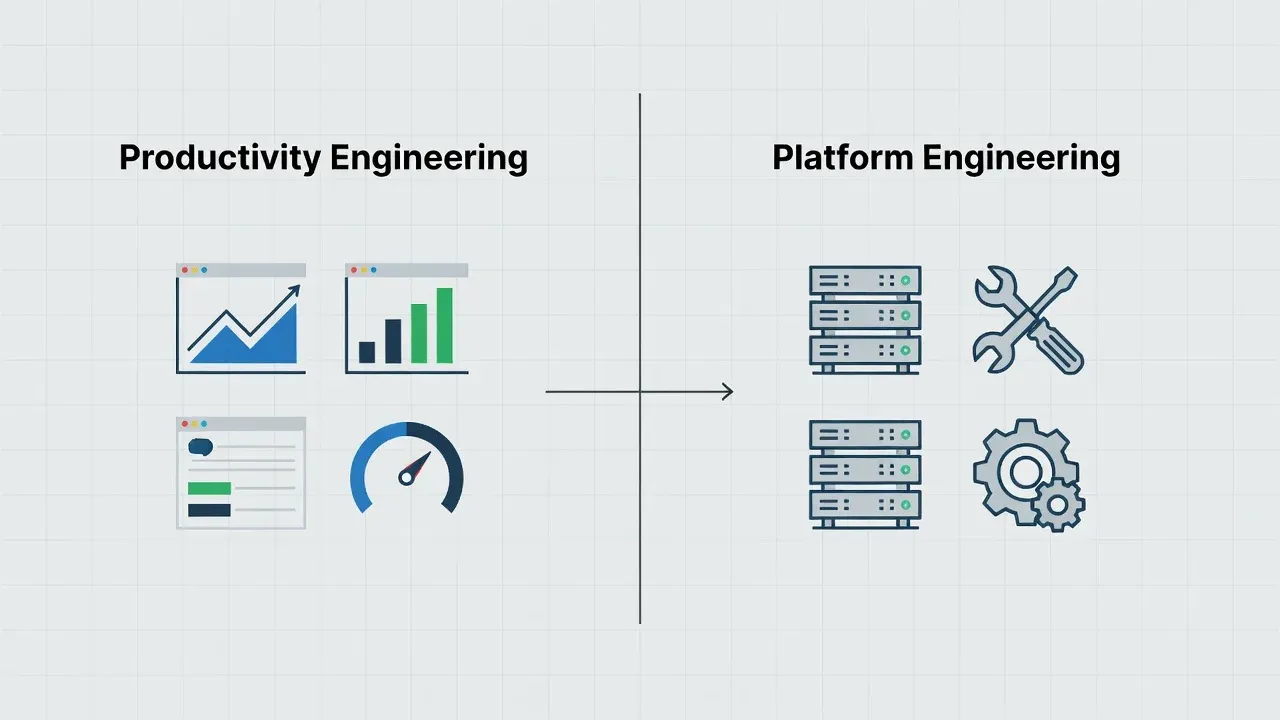
Platform Engineering increasingly needs to think like an internal platform provider:
- Reliability
- Scalability
- APIs
- Adoption
- Security
- Self-service
Productivity Engineering needs to stay close to the engineering workflow:
- Friction
- Feedback loops
- Automation
- Tooling
- Delivery speed
- Developer experience
- Engineering effectiveness
Even if the same organization contains both functions, understanding the distinction helps prevent every developer problem from becoming a platform project and every platform problem from becoming a productivity initiative.
Frequently Asked Questions
Is Productivity Engineering the same as Developer Experience?
Not exactly.
Developer Experience describes how engineers experience the systems, tools, processes, and environments around them.
Productivity Engineering actively improves those systems and workflows with the goal of helping engineers deliver software more effectively.
DevEx is therefore an important part of Productivity Engineering, but Productivity Engineering can also include automation, CI optimization, engineering metrics, AI enablement, technical debt reduction, and broader delivery improvements.
Does Platform Engineering improve developer productivity?
Absolutely.
Good platforms can dramatically improve productivity by eliminating infrastructure work and providing self-service capabilities.
The difference is that productivity improvement is usually a consequence of a good platform, while for Productivity Engineering it is the primary objective.
Which team owns CI/CD?
It depends on the organization.
Platform Engineering may own the underlying CI/CD platform and standardized pipelines.
Productivity Engineering may own improvements to the developer-facing experience, such as pipeline speed, feedback time, caching for CI/CD, test optimization, and workflow automation.
In practice, CI/CD is one of the areas where the two teams often collaborate most closely.
Which team owns SPACE metrics or developer satisfaction surveys?
Productivity Engineering usually owns or heavily influences these activities because the data helps identify friction and evaluate whether improvement programs actually work.
Platform Engineering may supply some of the underlying usage or pipeline data, but measurement itself is usually closer to the Productivity Engineering mandate.
Which team owns developer productivity metrics?
Productivity Engineering usually owns or heavily influences them.
Metrics such as cycle time, feedback-loop duration, developer satisfaction, build performance, and delivery friction help identify where improvements will have the greatest impact.
Metrics are an important tool for Productivity Engineering, but measurement is not the product.
The purpose of measuring productivity is to find opportunities to improve the engineering system.
What signals indicate that a company needs a dedicated Productivity Engineering function?
Look for repeated problems such as:
- Developers spending significant time waiting for builds or tests
- Slow or inconsistent feedback loops
- Repetitive manual engineering work
- Poor developer satisfaction
- Difficulty understanding whether engineering investments actually help
- Technical debt consistently slowing delivery
- AI tools being introduced without understanding their impact
- Developer tooling growing organically without clear ownership
Repeated requests for new internal platforms, golden paths, infrastructure abstractions, AI catalog context layer or self-service capabilities point more strongly toward expanding Platform Engineering.
How does AI change the distinction?
AI expands the scope of both teams.
Productivity Engineering looks for ways AI can remove repetitive work, accelerate feedback, improve coding workflows, build tools to help developers and reduce developer friction.
Platform Engineering provides the secure, scalable infrastructure required to make those AI capabilities available across the organization.
The same division still applies:
Productivity Engineering optimizes the engineering experience. Platform Engineering provides the shared foundation.
When should the two teams run a joint planning session?
A joint session makes sense whenever solving a productivity problem requires a shared platform capability, or when a new platform capability needs productivity measurements to prove that it actually helps developers.
The goal is not shared ownership of everything.
The goal is to identify the primary owner and make dependencies between the teams explicit.
The Bottom Line
Productivity Engineering and Platform Engineering are closely related, but they optimize different layers of the engineering organization.
Productivity Engineering focuses on engineers and their workflows.
It identifies friction, automates repetitive work, improves tooling, shortens feedback loops, and measures whether those changes actually help teams deliver better software.
Platform Engineering focuses on shared technical capabilities.
It creates platforms, infrastructure, APIs, golden paths, and self-service systems that allow engineering teams to build and operate software consistently at scale.
A simple way to remember the difference is:
Platform Engineering builds the road. Productivity Engineering makes the journey faster.
The strongest engineering organizations need both and better under the same leader.


Comments ()